Showing posts with label Chapter 3. Show all posts

Wednesday, October 28, 2015

Slide Images for October 28

 The Scottsboro Boys, with attorney Samuel Leibowitz, under guard by the state militia, 1932

 Ruby Bates & Victoria Price in 1931

 The crowd gathered outside the Scottsboro courthouse on April 6, 1931

 Protestors in Washington, D.C.
1935

Lovers
Ernest Crichlow
1938

 Harlem
Edward Burra
1934

 Havana Citizen
Walker Evans
1933

 The Brown Bomber
Robert Riggs
1939

 Book Jacket for The Negro Wage Earner
James Lesesne Wells
1930

 Mending Socks
Archibald Motley, Jr.
1924

 The Old Snuff Dipper
Archibald Motley, Jr.
1928

Octoroon Girl
Archibald Motley, Jr.
1925

Terms of the Day for October 28

  • Jim Crow Laws – state and local laws in the United States enacted between 1876 and 1965. They mandated de jure racial segregation in all public facilities in Southern states of the former Confederacy.
  • Proletariat – a term used to identify the working class in capitalist systems.  Members of this class do not have ownership of the means of production and therefore sell their labor to those who do.
  • Capitalism –  an economic system that is based on private ownership of the means of production and the creation of goods or services for profit. Other central elements include competitive markets, wage labor and capital accumulation.
  • Communism –  established by Karl Marx, a revolutionary socialist movement to create a classless, moneyless, and stateless social order structured upon common ownership of the means of production. The movement claims that since the world has a superabundance of material wealth, societies can allow distribution based on need and social relations  based on freely associated individuals.


Monday, October 26, 2015

Slide Images for October 26

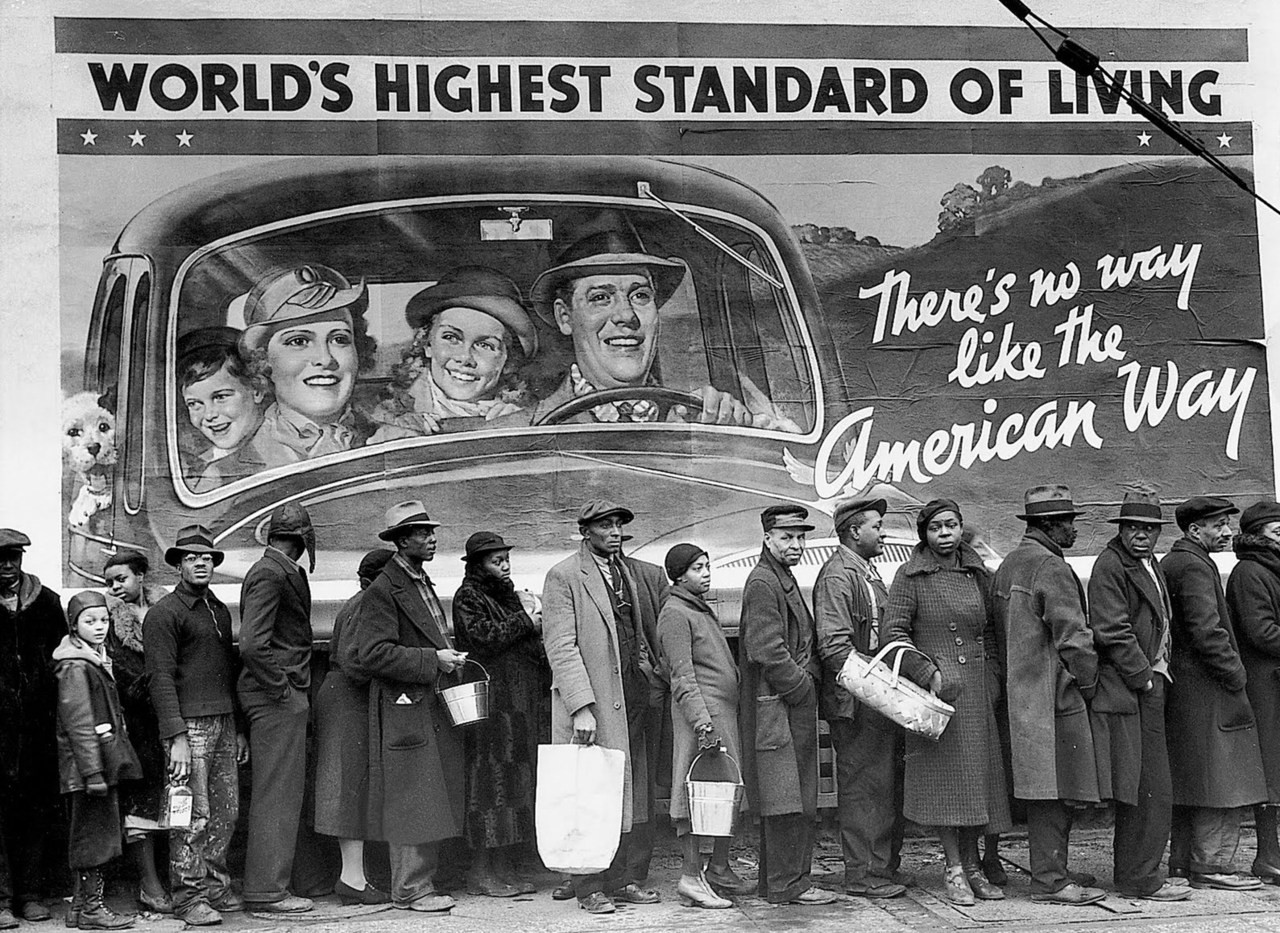
 Bread Line in Louisville, Kentucky
Margaret Bourke-White
1937

 Twenty Cent Movie
Reginald Marsh
1936

 Lord, Heal the Child
Thomas Hart Benton
1934

 Breaking the Prairie Sod
Grant Wood
1935-1937

 The Evolution of Negro Dance
Aaron Douglas
Harlem YMCA
1935

 Panel from Modern Medicine
Charles Alston
Harlem Hospital
1936


 Harlem Hospital Center Murals
Various Harlem Renaissance Artists
1936

 Between Acts
Archibald Motley, Jr.
1935

 Picnic
Archibald Motley, Jr.
1936

 Nous Quatre a Paris (We Four in Paris)
Palmer Hayden
c. 1930

Midsummer Night in Harlem 
Palmer Hayden
1936

Terms of the Day for October 26

  • The Great Depression – a decade of high unemployment, poverty, low profits, deflation, plunging farm incomes, and lost opportunities for economic growth and personal advancement which followed the Wall Street Crash of 1929 and eventually spread worldwide.
  • The New Deal – a  series of economic programs enacted in the United States between 1933 and 1936 in response to the Great Depression and focused on what historians call the "3 Rs": Relief, Recovery, and Reform. That is, Relief for the unemployed and poor; Recovery of the economy to normal levels; and Reform of the financial system to prevent a repeat depression.
  • Works Progress Administration (WPA) – the largest and most ambitious New Deal agency, employing millions of unskilled workers to carry out public works projects, including the construction of public buildings and roads.
  • Federal Art Programs (FAP) – was the visual arts arm of the Great Depression-era New Deal Works Progress Administration program in the United States.  It’s primary goals were to employ out-of-work artists and to provide art for non-federal government buildings: schools, hospitals, libraries, etc.


Friday, September 11, 2015

Slide Images for September 11

 Candi Loro Jonggrang
Prambanan, Central Java
9th Century

 Celestial Dancers from the  upper level of Candi Loro Jonggrang
Prambanan, Central Java
9th Century

 Scenes from the Ramayana on the balustrade of Candi Loro Jonggrang
Prambanan, Central Java
9th Century

 Candi Jawa
East Java
13th Century

 Stone Sculpture of Ganesha
Central Java
c. 9th-10th Century

 Shiva on a Double Lotus Pedestal
East Java
Late 13th Century

 Gunung Kawi
Bali
10th Century

 Goa Gajah
Bali
11th Century

 Bathing Pools facing the mouth of Goa Gajah
Bali
11th Century

 Pura Tanah Lot 
Bali
15th  or 16th Century

 Nang Yai Shadow Puppet
Wat Khanon
2008

Shadow Puppet representing Arjuna
Java
Contemporary

Terms of the Day for September 11


  • Hinduism – a religion including the worship of several gos and a belief in reincarnation, the law of karma, and a universal spirit.
  • The Ramayana – an ancient Sanskrit epic that forms an important part of the Hindu canon. Through a series of stories, it depicts the duties of relationships; portraying ideal characters like the ideal father, ideal servant, ideal brother, ideal wife, and the ideal king.
  • The Mahabharata - one of the two major Sanskrit epics of ancient India, the other being the Ramayana.  Besides its epic narrative of the Kurukshetra War and the fates of the Kauravas and the Pandava princes, the Mahabharata contains much philosophical and devotional material, such as a discussion of the four "goals of life".


Wednesday, September 9, 2015

Slide Images for September 9

 Prasat Phnom Rung
Thailand
12th Century

Carving of Shiva Nataraja, Prasat Phnom Rung
Thailand
12th Century

 Shivaite Brick Shrine
My Son, Vietnam
7th Century

 Dancer From Tra Kieu
Champa
10th Century

 Gajasimha (elephant-lion)
Champa
c. 12th Century

 Preah Ko
Angkor
10th Century

 Phimeanakas Temple
Angkor
9th Century

 Bakong Temple
Angkor
Built in various stages 881-12th Century

Angkor Wat
Angkor
12th Century

Terms of the Day for September 9


  • Hinduism – a religion including the worship of several gods and a belief in reincarnation, the law of karma, and a universal spirit.
  • Champa Kingdom – (CHUM-pah) the kingdom of the Chams situated in what is now central Vietnam, lasting from the end of the 2nd to the start of the 19th century.
  • Khmer Empire – (kuh-MEH) one of the most powerful empires in Southeast Asia. The empire, which grew to power in the first millennium AD, at times ruled over parts of modern-day Laos, Cambodia, Thailand, Vietnam, Burma, and Malaysia.
  • Angkor – (ANG-core) meaning “Holy City”, a region of Cambodia that served as the seat of the Khmer Empire.  The region flourished from approximately the 9th to 15th centuries.
  • Mount Meru – (meh-ROO) in Hindu belief, a mountain at the center of the cosmos and home of the gods, around which the entire universe revolves.